Introduction
Artificial intelligence (AI) is a branch of computer science that focuses on building systems that can learn, reason, and solve problems. In simple words, it’s about creating machines that can do things that normally require human thinking, like speech and judgment.
AI is increasingly being used in our daily lives to make communication easier, so it is important to understand exactly what AI is and why it is being discussed everywhere. Artificial intelligence (AI) is a branch of computer science that focuses on building systems that can learn, reason, and solve problems.
In simple words, it’s about creating machines that can do things that normally require human intelligence, like speech and decision-making.
How Does Artificial Intelligence Work?
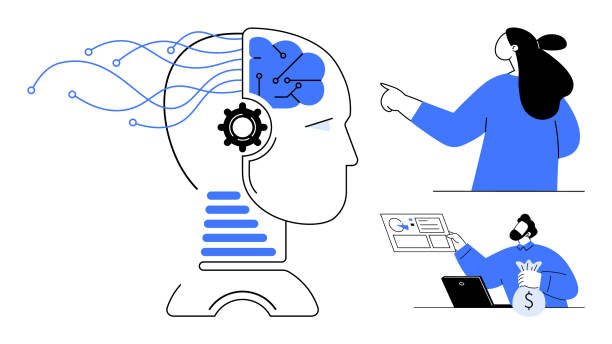
AI operates by combining data, algorithms, and computational power, enabling machines to perform tasks that typically require human intelligence. AI systems gather vast amounts of data, identify patterns within it, and use those patterns to make predictions and decisions.
This process begins with collecting various types of data, such as text, images, videos, and numerical data, to train an AI model. During training, AI analyzes this data and identifies the relationships within it. The quality of the data provided directly determines the AI system’s performance; the better the data, the more accurately and effectively the system performs.
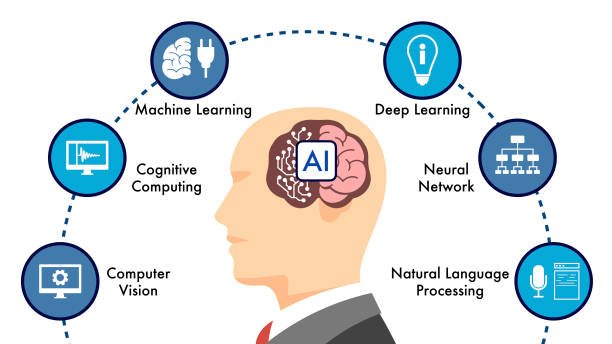
Machine learning is just a part of artificial intelligence, where computers learn from experience independently. You do not need to code everything for every single situation. Then comes deep learning, which is a bit more advanced. It uses neural networks that work like a human brain. That’s how AI manages to understand tough things like voices, pictures, and how people naturally talk..
Once an AI model has been trained, it can analyze new information and generate results in real time. For example, AI can recognize faces in images, understand spoken language, recommend movies or products, detect fraudulent financial transactions, answer questions, and even generate text, images, music, and computer code.
What is the History of Artificial Intelligence?
AI began as a philosophical idea long before computers:
- 1950: Alan Turing introduced the concept of machine thinking
- 1956: Dartmouth Conference, birth of the AI field
- 1970s–1980s: Early AI systems were developed, and the rise of expert systems
- 1997s: Machine Learning revived AI using big data + computing power
- 2012: Deep Learning breakthrough changed everything
- 2020s–2026: Explosion of AI tools and real-world applications
Key Milestones in the History of Artificial Intelligence
Artificial intelligence has gone through many milestones over the past 70 years. Each stage has played a crucial role in the development of the modern AI systems we use daily. Reflecting on and understanding this historic journey helps us see how Artificial Intelligence began and how it has developed into a powerful technology used around the world.
Types of Artificial Intelligence
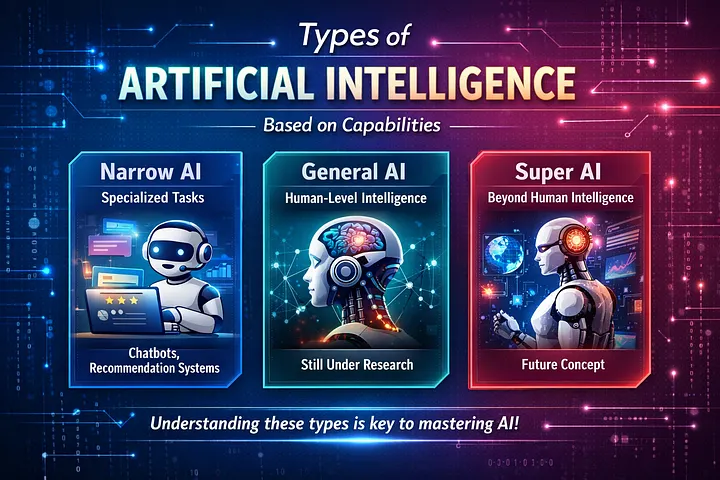
Artificial Intelligence (AI) can be classified in different ways based on its capabilities and functionality. Understanding these types helps explain how AI systems work and what they can do. The most common classification is based on capability, which includes Narrow AI, General AI, and Super AI.
1. Narrow AI (Artificial Narrow Intelligence – ANI)
Artificial Narrow Intelligence is a simple and common type of Artificial intelligence. Narrow AI works on a specific or limited task. Although Narrow AI can perform these tasks with proper accuracy and speed, it cannot think beyond its programmed purpose.
An example of Narrow AI includes a virtual assistant and Google Assistant.
2. General AI (Artificial General Intelligence – AGI)
The concept of Artificial General Intelligence (AGI) represents a theoretical concept in the field of AI; it refers to a system capable of understanding, learning, and performing any task—just like a human being.
General Artificial Intelligence does not yet exist; researchers around the world are working on it, and research is being conducted worldwide.
3. Super AI (Artificial Super Intelligence – ASI)
Artificial Superintelligence (ASI) is a hypothetical future technology form of AI that would surpass human intelligence in almost every field, including scientific research, creativity, decision-making, and problem-solving. While Super AI is a popular topic in research and science fiction, it does not currently exist.
Researchers continue to study its potential benefits, challenges, and ethical implications to better understand how such technology could affect society if it ever becomes possible.
Advantages of AI
AI is bringing changes in different industry sectors because AI is doing work faster and more effectively than humans.
Reduces Human Effort
It helps reduce the need for repetitive tasks.
Examples:
- Chatbots answering customer queries
- Automation in data entry
- Robots in manufacturing
Improves Accuracy
If we trained AI systems properly, they could perform tasks very well with fewer errors.
Examples:
- Medical diagnosis systems detect diseases
- Fraud detection in banking
- Spell check and grammar correction tools
Handles Large Amounts of Data
AI can process a large amount of data in a short time, which is impossible for humans.
Examples:
- Customer behavior analysis in e-commerce
- Big data analytics in finance
- Social media trend analysis
Automates Tasks
Automation is one of the biggest advantages of AI because it helps automate repetitive and routine tasks.
Examples:
- Email automation
- AI-powered scheduling tools
- Self-driving cars
- Saves time
- Increases productivity
- Reduces operational costs
24/7 Availability (Additional Advantage)
Unlike humans, AI systems can work continuously without breaks.
Examples:
- Customer support chatbots
- Online services
- Monitoring systems
Faster Decision Making
AI can analyze data and make decisions much faster than humans.
Examples:
- Traffic management systems
- Stock market predictions
- Real-time fraud detection
Challenges of Artificial Intelligence
Although AI has many benefits, it also comes with several challenges and limitations.
High Implementation Cost
Developing and maintaining AI systems can be very expensive.
It is costly because it requires powerful hardware and skilled professionals.
Examples:
- Building AI models
- Infrastructure costs (servers, cloud computing)
Data Dependency
AI systems depend heavily on large amounts of quality data.
AI depends heavily on data. If the data is poor or incomplete, it can produce inaccurate results, and collecting high-quality data can be difficult.
Examples:
- Incomplete datasets affecting predictions
- Biased data leading to unfair outcomes
Job Displacement Fears
Automation can replace certain types of jobs, especially repetitive and manual roles.
Conclusion
When you are first starting, the main thing is to start with things you do all the time and think about what you can really use. This way, you will get better at the things you want to learn.
How to get a job in AI?
If you want to get a job in AI, you need to learn about Artificial Intelligence and practice it a lot.
Frequently Asked Questions (FAQs)
AI is a branch of computer science that enables machines to perform tasks that typically require human intelligence, such as learning, reasoning, problem solving, and decision making.
AI works by looking at a lot of information, finding things that are the same, and using special rules to make guesses or choices. Many new AI systems get better at what they do as time goes on through something called machine learning. AI systems, like these, use machine learning to improve how they work.
The three main types of AI are Narrow AI (designed for specific tasks), General AI (a theoretical AI with human-like intelligence), and Super AI (a hypothetical form of AI that surpasses human intelligence).
Artificial Intelligence is an area that is all about making machines smart. Machine Learning is a part of AI that helps computers figure things out from data on their own, so they do not need to be told what to do every time.
AI and Machine Learning are related. Machine Learning is special because it lets computers learn from data without someone having to program them for each task.
Artificial intelligence is used in assistants like Siri and Google Assistant. These AI systems help us with our tasks. We also see intelligence in recommendation systems on Netflix and YouTube.AI is used in chatbots that talk to us when we need help.
Anyone can start learning AI with computer skills by being curious and practicing all the time. People who are just starting usually begin with Python, the basics of mathematics, and an introduction to machine learning concepts. Artificial Intelligence is really cool. You can learn it if you practice AI every day.
AI offers a lot of types of jobs. You can be an AI Engineer or a Machine Learning Engineer. Some people work as Data Scientists or AI Researchers. There are also jobs like Computer Vision Engineer and Natural Language Processing Engineer. Then there are Robotics Engineers and AI Product Managers.
The need for AI Engineers and all these other roles just keeps going up in all kinds of industries.